
Mistletoe Meaning, Holly & Ivy: Celtic and Druid Christmas Greenery
Quick answer: The mistletoe meaning that comes down from the Celts is life and healing: the Roman writer Pliny recorded that druids in Gaul prized mistletoe growing on oak and called it by a word meaning all-healing. Holly, cuileann in Irish, was Ireland's own Christmas green, plentiful and protective. Ivy stood for faithful, clinging life. Kissing under mistletoe came much later, in 18th-century England.
It is the second week of December somewhere in the west of Ireland. A child is sent out the back door with a pair of shears and strict instructions: only the branches with berries, and don't strip the tree. She comes back with cold hands and an armful of holly, and her grandmother tucks a sprig behind every picture frame in the kitchen. The Sacred Heart gets the best piece.
Ask most people about the mistletoe meaning and they will mention a kiss. Ask an Irish grandmother about Christmas greenery and she will talk about holly. Both answers are right, and both sit on top of a much older story about why people in the darkest weeks of the year bring living green things indoors.
This is that story: what the druids were said to believe about mistletoe, why holly became Ireland's Christmas plant, what ivy meant, and which parts of the tale are ancient and which are surprisingly modern. Along the way we will look at the Irish jewelry that carries the same ideas, starting with our Celtic Tree of Life Necklace, a piece rooted in the sacred trees of Irish tradition.
The Mistletoe Meaning in Pliny's Account of the Druids
Almost everything we picture about druids and mistletoe comes from a single paragraph. Around the year 77 AD, the Roman naturalist Pliny the Elder finished his enormous Natural History. In Book XVI, chapter 95, he paused his discussion of trees to describe what he had heard of the druids of Gaul.
According to Pliny, the druids held nothing more sacred than mistletoe and the tree it grew on, provided that tree was an oak. Mistletoe on oak was rare, he wrote, and when it was found it was gathered with great ceremony, ideally on the sixth day of the moon. The people called it by a word in their own language meaning all-healing.
Then comes the scene that has fixed itself in the popular imagination. A banquet and sacrifice were prepared beneath the tree, and two white bulls were led forward, their horns bound for the first time. A priest dressed in white climbed the oak and cut the mistletoe with a golden sickle, and it was caught in a white cloak below. The bulls were sacrificed with prayers that the god would make his gift a blessing. Mistletoe taken in a drink, the druids believed, would make barren animals fertile and serve as an antidote to all poisons.
A Roman telling, not a druid one
It is worth being clear about what this account is. Pliny was a Roman writing about a people Rome had recently conquered, and he did not name his source. Some historians think he drew on the Greek writer Posidonius, who traveled in Gaul generations earlier. Pliny is the only ancient writer who describes the ritual at all. The druids themselves left no written record, so we have no way to hear their side.
Scholars still take the passage seriously, because its main elements, oak, the moon, feasting, and bull sacrifice, turn up elsewhere in Celtic religion. And one claim we can correct outright: mistletoe is no cure for poison. Every part of European mistletoe is toxic, so keep those berries away from children and pets.
Read carefully, the oldest mistletoe meaning is about life. Here was a plant that stayed green and bore white berries in midwinter, high on a bare oak, apparently rooted in nothing. To people watching the days shorten, it looked like proof that life could survive the dark.
Why Ireland Chose Holly
Here is a fact that surprises many Irish-Americans: mistletoe is not native to Ireland. The Irish Wildlife Trust notes that it grows at only about a dozen known sites on the island, some of them in old gardens, probably a legacy of Victorian attempts to cultivate it. It does have an Irish name, drualas, but for most of Irish history, nobody had any to hang.
Holly, on the other hand, was everywhere. It grew in hedgerows and woods across the whole country, and it was free. A family with nothing to spend on decorations could still fill a cottage with glossy green and red. Long before shop-bought tinsel, holly on the windowsill, over the door, and around the holy pictures was what Christmas looked like in rural Ireland.
Holly also carried weight in early Irish law. The Bretha Comaithchesa, a legal text on the laws of the neighborhood, ranked trees by value. Holly, cuilenn in Old Irish, stood among the seven airig fedo, the nobles of the wood, alongside oak, hazel, yew, ash, Scots pine, and wild apple. Damaging one of those trees carried a heavier penalty than harming a lesser one. Holly's hard wood was valued for chariot shafts and spear handles, and its leaves were cut as winter fodder for cattle.
Holly in Irish folklore
Folk belief gave holly a protective role. Its prickles were said to catch any ill-wishing spirit trying to get into the house. Families cut only small sprigs, because cutting down a whole holly tree was thought to bring bad luck. And once the holly came in, it stayed up through the twelve days. Taking it down before Little Christmas, Nollaig na mBan, on January 6 was asking for trouble. You can read more in our post on Nollaig na mBan, Women's Christmas.
In the Christian telling that grew up later, the holly's sharp leaves recall the crown of thorns and its red berries the drops of Christ's blood. Many Irish families hold both meanings at once, the protective and the devotional, which is a very Irish way to keep a tradition.
Medieval Irish scholars also linked holly to the Ogham alphabet, the old Irish script of strokes cut along a stone's edge. They glossed the letter tinne as holly, though modern scholars note that the original meaning of the letter name is uncertain.
Ivy: The Green That Clings
Ivy, eidhneán in Irish, is the quieter member of the trio. It climbs stone walls and old churches across Ireland and stays green through the hardest winter. Medieval scholars glossed the Ogham letter gort as ivy, and in folk tradition its habit of holding fast made it a sign of fidelity and enduring friendship.
Ivy had a mixed reputation in the early Christian period, since it was linked with shady places and the old pagan revels of the classical world, but it found its way into the Christmas bundle all the same. The pairing of holly and ivy is best known from the English carol "The Holly and the Ivy," and in many Irish homes the two went up together over the hearth.
Think of the way ivy twines endlessly around a tree, no beginning and no end. That is exactly how Celtic knotwork works. The interlace in the Book of Kells, made around the year 800, wraps and weaves in unbroken lines, and the Trinity knot is the simplest form of the idea: three loops, one continuous thread.
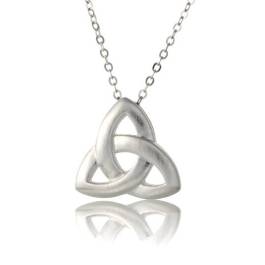
Sterling Silver Modern Trinity Knot Necklace
$129.99
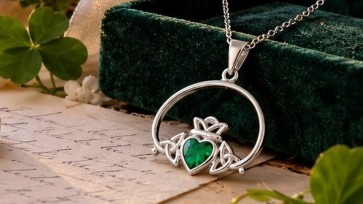
Like ivy wound around an old oak, the Trinity knot never breaks. This modern sterling silver version keeps the line clean and simple, a gift that reads as faith, family, or lasting love.
Shop the Modern Trinity KnotOur Trinity knot guide covers the symbol's history in more detail.
The Oak at the Heart of It All
Go back to Pliny's account and notice what made the mistletoe sacred. It was the oak. The druids, he says, would perform no rite without oak leaves, and he even guessed that their name came from the Greek word for oak. Modern linguists connect the word druid to an old Celtic root meaning something like "oak-knower" or "strong knowledge," though they still debate it.
Ireland's map still carries the oak. Derry comes from Doire, an oak grove. Kildare is Cill Dara, the church of the oak, where St. Brigid founded her monastery in the fifth century beside a great oak tree. In early Ireland, a sacred tree, a bile, often stood at the place where kings were inaugurated, and to cut one down was a grievous insult to the people who gathered there.
This is the thinking behind the Celtic Tree of Life: the tree as the link between the earth below and the sky above, roots and branches mirroring each other, the family growing from one trunk. It is the symbol that gathers the meanings of holly, ivy, mistletoe, and oak into a single design.

Celtic Tree of Life Necklace
$139.99
Its roots and branches weave together in Celtic knotwork, the sacred oak of the druids made wearable. This is our favorite gift for the woman who decorates her mantel with real greenery every December.
Shop the Celtic Tree of Life NecklaceFor a milestone Christmas, a first year married, a new grandmother, a 40th birthday that lands in December, the Silver & 10K Diamond Tree of Life Pendant Necklace adds a touch of sparkle to the same symbol, like frost on bare branches.
The Norse Story and the English Kiss
Two other stories often get blended into the mistletoe meaning, and neither is Celtic.
Frigg, Baldur, and the mistletoe dart
The first is Norse. In the Prose Edda, written down in Iceland by Snorri Sturluson in the 13th century, the goddess Frigg asks every living thing to swear never to harm her son Baldur. She skips the mistletoe, thinking it too young to matter. The trickster Loki has a dart made of mistletoe and guides the blind god Höðr to throw it, and Baldur dies. Later popular retellings give the tale a happier ending, with Frigg declaring the mistletoe a plant of love, but that version is not in Snorri. It is a lovely story, and it belongs to Scandinavia.
Kissing under the mistletoe
The second is the kiss. By the 18th century, mistletoe was a common Christmas decoration in England, and the custom of stealing a kiss beneath it seems to have caught on among servants before spreading to middle-class households. Each kiss meant plucking one berry, and when the berries were gone, so was the kissing. Refusing a kiss was said to bring bad luck. The custom traveled with English settlers and Victorian Christmas cards, and that is how it reached America and, eventually, Ireland.
So if you hang mistletoe this year, you are honoring an English parlor game more than a druid rite. Nothing wrong with that. Just don't let anyone tell you the druids invented it.
Where the Holly King and Oak King Fit
You may have seen the Holly King and Oak King on cards or in winter solstice posts. In this story, the two kings battle twice a year: the Oak King wins at midwinter and rules the growing light, and the Holly King wins at midsummer and rules the waning year.
It is a beautiful image, and it does draw on very old plants. But the story itself is a modern neopagan tradition, shaped in the 20th century and influenced by Robert Graves's 1948 book The White Goddess and by modern Wicca. You will not find it in early Irish law, the old sagas, or the folklore collected from Irish homes. Enjoy it for what it is: a new myth built from old greenery.
The real ancient midwinter moment in Ireland is older than any of these stories. At Newgrange in County Meath, a passage tomb built more than 5,000 years ago, the rising sun on the winter solstice shines down the passage and lights the inner chamber. Our post on Newgrange and the winter solstice tells that story.
Carrying the Green Through the Year: Connemara Marble
Holly comes down after Little Christmas. The green doesn't have to. Connemara marble, quarried in the rugged west of County Galway, is Ireland's own green stone, streaked in shades from pale sage to deep forest. It is the color of a holly leaf in a stone you can wear every day.

Connemara Marble Tree Of Life Ring Sterling Silver
$169.99
The sacred tree and the evergreen color of Irish winter in one ring. Green Connemara marble sits under the silver Tree of Life, so the meaning of the season stays on her hand all year.
Shop the Connemara Tree of Life RingFor a smaller gift, a stocking or a Kris Kindle at work, the Heart of Connemara Necklace sets the green stone in a heart, and the Celtic Knot Tree of Life Earrings carry the tree in knotwork for an easy everyday pair. Our guide to Connemara marble jewelry explains how the stone is cut and cared for.


Bringing the Old Greens Home This Christmas
If you want to keep the tradition, start simply. Cut a few sprigs of holly, never the whole tree, and put them over the door and behind the holy pictures. Bring in ivy for the mantel. If you want mistletoe, buy it, hang it high, and keep the berries away from little ones. Light a candle in the window on Christmas Eve, Thursday, December 24, as Irish families have done for generations. Then leave everything up until Wednesday, January 6, 2027, Little Christmas.
And if there is someone on your list who loves this season of green and gold, give her something that keeps it going. A Tree of Life, a Trinity knot, a piece of Connemara marble. They carry the same promise the greenery always did: the light comes back, and life holds on.
Frequently Asked Questions About Mistletoe Meaning and Celtic Christmas Greenery
What is the meaning of mistletoe?
The mistletoe meaning most people know is romance, from the English custom of kissing beneath it. Older meanings are about life and healing. Pliny the Elder recorded that Gaulish druids called it by a name meaning all-healing and believed it brought fertility. Green on bare winter branches, it stood for life surviving the dark.
Did the druids really cut mistletoe with a golden sickle?
That image comes from one source, Pliny the Elder's Natural History, Book XVI, written in the first century AD by a Roman. He describes a white-robed priest cutting mistletoe from an oak with a golden sickle and catching it in a white cloak. No druid account survives, so scholars treat it with care.
Is kissing under the mistletoe an Irish or Celtic tradition?
No. Kissing under the mistletoe is an English custom that took hold in the 18th century, apparently first among servants, before spreading to middle-class homes. Mistletoe is not even native to Ireland, where it grows wild at only a handful of sites, so Irish homes traditionally relied on holly.
What does holly mean in Irish tradition?
Holly, cuileann in Irish, was the everyday Christmas green in Ireland because it grew everywhere and cost nothing. Early Irish law listed it among the seven nobles of the wood. Folklore held that it protected a house, and many families keep it up until after Little Christmas on January 6.
What do the Holly King and Oak King mean?
The Holly King and Oak King are figures from modern neopagan practice, who battle at the solstices for rule of the waning and waxing year. The idea was shaped in the 20th century, partly by Robert Graves's The White Goddess. It is a modern tradition, not an ancient Irish one.
What jewelry symbolizes holly, ivy, and mistletoe?
The Celtic Tree of Life is the closest match, since it draws on the sacred trees of Irish tradition, the oak above all. Trinity knots and Celtic knotwork echo ivy's endless twining, and green Connemara marble carries the evergreen color of the season into a piece she can wear all year.
About the author
Jennifer Derrig is the founder and creative director of The Irish Jewelry Company, which she started in 2006. A FIT-trained jewelry designer and the author of The Heritage Brand: How to Build a Heritage Brand People Love, she designs pieces that carry Irish heritage into everyday life.
Give the gift of Ireland's sacred trees this Christmas
Shop the collectionKeep reading: Christmas in Ireland: A Story of Irish Christmas Tradition · The Irish Christmas Tradition of a Candle in the Window · Newgrange, the Winter Solstice and Celtic Spirals · The Ultimate Guide to Connemara Marble Jewelry · Shop Trinity knot jewelry