
Irish Santa Claus Traditions: Daidí na Nollag & St. Nicholas
Quick answer: The Irish Santa Claus is called Daidí na Nollag, or more often just "Santy." On Christmas Eve, Irish children leave him a mince pie and a glass or bottle of Guinness, with a carrot for the reindeer. A local legend in County Kilkenny even claims St. Nicholas himself is buried at Newtown Jerpoint, though his relics are honored in Bari, Italy.
It is ten o'clock on Christmas Eve in a terraced house in Dublin, and the fire has been let die down. On the hearth sits a plate with one mince pie, a glass of Guinness poured an hour ago and gone flat, and a carrot, scrubbed clean, for Rudolph. Two small children in pajamas are being steered toward the stairs. One of them turns back to check the plate one more time. "Will Santy know we're here?"
He will. The Irish Santa Claus has been finding his way down Irish chimneys for well over a century, and Irish families have their own way of welcoming him. He has an Irish name, Daidí na Nollag. He has an Irish appetite. And according to one stubborn legend in County Kilkenny, the saint who inspired him may have ended up in an Irish graveyard.
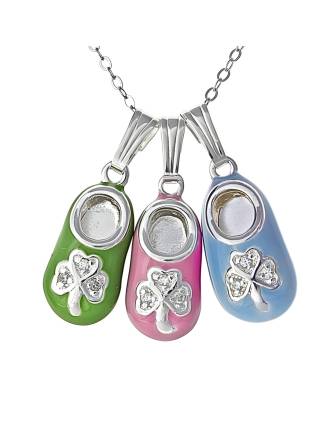
Christmas in Ireland has always been about children and family, and a baby's first Christmas is a day the whole extended family remembers. That is why so many of our customers mark it with a small piece of jewelry that can be kept for life, like the Personalized Irish Baby Bootie Charm Necklace. But first, let's meet Santy.
Who Is Daidí na Nollag? The Irish Santa Claus
Daidí na Nollag is the Irish name for Father Christmas. It means, quite simply, "Daddy of Christmas." Nollaig is the Irish word for Christmas, and you will hear it in the greeting Nollaig Shona Duit, Happy Christmas to you. (If you'd like to learn to say it properly, our guide to Merry Christmas in Irish walks you through it.)
In everyday speech, though, most Irish children don't say Daidí na Nollag or even Santa Claus. They say Santy. "Did Santy come?" is the first question asked in Irish houses on Christmas morning, and the answer is shouted down the stairs before anyone has their slippers on.
The Irish Santa Claus looks much like his cousins around the world: red suit, white beard, sack of toys. But the welcome he gets is particular to Ireland. From late November, shopping centres and department stores across the country set up a Santa's grotto, and queuing to see Santy is a December ritual for Irish families. Children whisper what they'd like, receive a small present, and leave with a photograph that ends up on the fridge for the rest of the year.
The Late Late Toy Show
For many Irish children, the Christmas season truly begins on the last Friday of November with The Late Late Toy Show on RTÉ One. It is one of the most-watched programs on Irish television every year. Children demonstrate the year's toys, the studio audience dresses for Christmas, and Santy's lists are revised in houses up and down the country before the credits roll.
What Irish Children Leave Out for Santy
In America, Santa gets milk and cookies. In Ireland, he gets a mince pie and a drink of Guinness, with a carrot left out for the reindeer. Some families pour a glass of stout, some leave the bottle, and in plenty of houses it is a glass of whiskey or a cup of tea instead. The mince pie is the constant. It is the taste of an Irish Christmas: pastry, dried fruit and spice, warmed by the fire.
It is a thoroughly grown-up snack for a man with a long night ahead, and Irish parents will tell you, with a straight face, that Santy needs something to keep the cold out. On Christmas morning, the empty glass and a few crumbs on the plate are the proof children look for first.
Letters to Santy in the fireplace
Irish children write to Santy too. Today most letters go in the post, and every year An Post's Santa letters arrive at sorting offices by the sackful. But in older Irish homes, letters were often left in the fireplace, where Santy would find them on his way down the chimney.
There is a lovely piece of evidence for this. In 1992, a man installing central heating in a house in Dublin found a letter tucked on a brick ledge inside the fireplace. It had been written on Christmas Eve, 1911, by two children who signed themselves "A or H Howard." They asked Santy for a baby doll, a hooded waterproof, gloves, a toffee apple, a gold penny, a silver sixpence and a long toffee, and they wished him good luck on his journey. It had sat in the chimney for eighty years, waiting.
Some families still keep the custom: the letter goes up the chimney, or on the mantelpiece, and Santy collects it on his rounds.
Christmas Eve in Ireland: The Candle and the Open Door
Before the children go to bed on Christmas Eve, there is one more job. A candle is placed in the front window and lit. Traditionally it was the youngest child in the house who lit it, or the mother. The candle welcomed Mary and Joseph, who found no room at the inn in Bethlehem, and by extension any traveller or stranger in need of shelter on the holy night. In many places the door was left unlocked as well.
In some parts of Ireland, three candles were lit for the Holy Family, and letting the candle go out by accident was thought to bring bad luck for the coming year. We've written about the full story in the Irish Christmas tradition of a candle in the window. In emigrant families, the candle took on another meaning: a light for the son or daughter far away who could not come home that year.
So the Irish Christmas Eve holds two welcomes side by side. A candle for the Holy Family. A mince pie for Santy. One for faith, one for fun, and both lit by the children.
A first Christmas keepsake
The youngest child lights the candle. On a baby's first Christmas, that honor is held for them, often by a proud older sibling or a grandparent with a hand on the match. It is a moment worth marking with something that lasts longer than the wrapping paper.
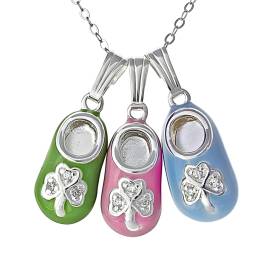
Personalized Irish Baby Bootie Charm Necklace Sterling Silver
$89.99
For the new mother on her baby's first Christmas. A tiny Irish bootie, personalized, worn close to the heart on the morning Santy makes his first visit to her child.
Shop the Baby Bootie NecklaceThe Legend of St. Nicholas in Kilkenny
Every Santa Claus story leads back to one man: Nicholas, a 4th-century bishop of Myra, in what is now southern Turkey. He was remembered for his generosity, especially to children and the poor. The most famous story tells of three gold purses tossed through a window at night so that three poor sisters would have dowries. His feast day is December 6, which falls on a Sunday in 2026, and over centuries his gift-giving reputation grew into the figure of Santa Claus.
Most of the world agrees on where St. Nicholas rests. In 1087, sailors from the port city of Bari carried his relics from Myra to Italy, and they have been honored in the Basilica of St. Nicholas in Bari ever since. Pilgrims travel there from all over the world.
But in County Kilkenny, they tell a different story.
Newtown Jerpoint: a saint in an Irish graveyard?
A short walk west of Jerpoint Abbey, the great Cistercian ruin near Thomastown, lie the remains of a lost medieval town called Newtown Jerpoint. All that is left are low walls, field boundaries and the ruined church of St. Nicholas, dating from the 12th and 13th centuries. In its graveyard is a carved stone slab showing a cleric, with the heads of two knights at his shoulders.
Local legend says that slab marks the grave of St. Nicholas himself.
The story comes in more than one version. In the simplest, two Norman knights returning from the Crusades brought the saint's remains home with them to Kilkenny. In a fuller version, a Norman family called de Frainet took the relics from Myra to Bari, then carried them to Nice in France, and finally to Ireland, where a Nicholas de Frainet, who held land near Thomastown, had them buried at Jerpoint around the year 1200. The two knights carved on the slab are said to be the crusaders who carried him.
We should be clear: this is folklore. There is no historical proof that St. Nicholas is buried in Kilkenny, and his principal relics remain in Bari. But the legend is not as strange as it sounds. Norman knights did go on crusade, Norman settlers in Kilkenny did collect relics, and medieval Europe was full of churches claiming a piece of a famous saint. The people of Newtown Jerpoint dedicated their church to Nicholas for a reason. Whatever lies under that slab, it has been honored there for centuries.
And there is something very Irish about the idea that Santa Claus, after all his travels, might have chosen to rest in a quiet field in Kilkenny.
Christmas Morning Mass and the Irish Santa Claus Morning
Christmas Day in Ireland is Nollaig Mhór, Big Christmas. For generations it began in the dark with Mass. Midnight Mass on Christmas Eve is a favorite for many Catholic families, and early Christmas morning Mass was once believed to bring special blessings. Even people who rarely went to church through the year were expected at Mass on Christmas, and the parish church would be full to the doors, coats steaming, children fidgeting, the crib lit at the side altar.
Then home, to the stockings and the Santy presents, opened in a rush. In recent decades a new custom has joined the old ones: the Christmas morning sea swim. At the Forty Foot in Sandycove and at Blackrock in Salthill, crowds plunge into the freezing Irish Sea and Atlantic, many raising money for charity, before going home to dinner.
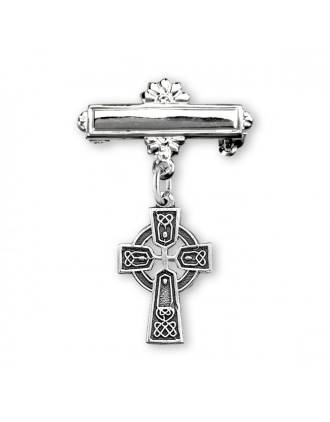
For a baby's first Christmas Mass, families often dress the little one in their best, and many choose a small piece of religious jewelry as a first-Christmas gift, something blessed that can be pinned on now and kept for First Communion and beyond.


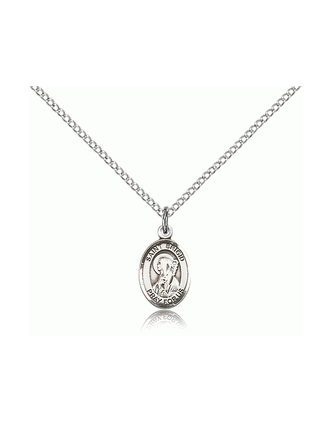
St. Nicholas is the patron of children, but Ireland has its own protectors too. St. Patrick and St. Brigid are the patron saints of Ireland, and a petite medal of either one is a traditional gift from a godparent. Brigid in particular, the saint of Kildare, was known for her generosity to the poor, which makes her a kindred spirit to Nicholas.
Gifts From Santy: Irish Jewelry for Children's First Christmas
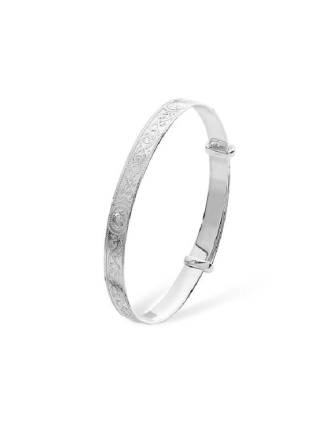
The toys from Santy get outgrown. The jumper from Auntie gets passed down. But a baby bangle from a first Christmas is the kind of thing a grown woman takes out of a drawer thirty years later and holds in her palm. It is how Irish families have always marked the beginning of a life: something small, made to last, given with a blessing.
The Trinity knot, with its three interlaced arcs and unbroken line, has long been read as a symbol of the Holy Trinity and of eternal love. For a baby, it speaks of a family bond that has no beginning and no end. Our guide to the Trinity knot explains more.

Trinity Knot Baby Bangle
$149.99
A first-Christmas bangle carrying the unbroken Trinity knot. Something for Santy to leave under the tree that will still be treasured long after the toys are gone.
Shop the Trinity Baby Bangle
Engraved Celtic Baby Bangle
$189.99
Like the 1911 letter found in that Dublin chimney, an engraved piece carries a name and a moment forward through the years. A family heirloom from the very first Christmas.
Shop the Engraved Baby BangleA family keepsake for Mam
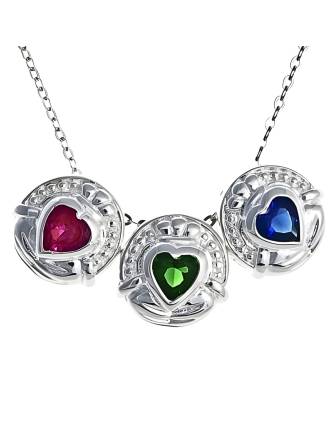
Christmas morning belongs to the children, but it is built by the mothers and grandmothers who wrapped every present and stuffed every stocking. A family birthstone necklace, with a stone for each child, is a gift that says thank you for all the Christmases.
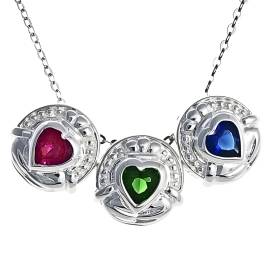
Claddagh Family Birthstone Necklace Personalized Necklace
$39.99
The Claddagh's hands, heart and crown with a birthstone for each child. For the mother who makes Santy's visit happen every year.
Shop the Family Birthstone NecklaceOrdering a first-Christmas or family gift? Please check our holiday cut-off dates before ordering, especially for personalized and engraved pieces: In-stock pieces ship in one business day. See our holiday shipping deadlines for Christmas delivery dates by shipping method..
After Santy Leaves: St. Stephen's Day to Women's Christmas
The Irish Christmas does not end when the wrapping paper goes in the bin. December 26 is St. Stephen's Day, Wren Day, when the wren boys once went from house to house in straw hats and masks, playing music and collecting money. In 2026 it falls on a Saturday, giving many families a long weekend of visiting. Read more in our post on St. Stephen's Day.
The season closes on January 6, Little Christmas, also called Nollaig na mBan or Women's Christmas. Tradition holds that on this day the women of the house, who had cooked and cleaned all through Christmas, finally put their feet up while the men took over, and the women went out together for tea or a drink. In 2027 it falls on a Wednesday. The days between Christmas and Little Christmas were known as "between the two Christmases," a gentle stretch of rest and visiting. Our post on Nollaig na mBan tells the full story.
Bringing Irish Santa Claus traditions home
- Swap the cookies for a mince pie. Leave Santy a mince pie and a small glass of stout, with a carrot for the reindeer.
- Put the letter in the fireplace. Have the children leave their letter on the mantel or hearth for Santy to collect.
- Light the Christmas Eve candle. Let the youngest child light it, with help, before bed.
- Teach the Irish name. Tell the children that in Ireland he is Daidí na Nollag, and practice saying Nollaig Shona.
- Tell the Kilkenny legend. Children love the idea that St. Nicholas might be buried in an Irish field. Just be sure to call it a legend.
- Mark the first Christmas. Choose one keepsake that will be kept for life, and write the year on the box.
Frequently Asked Questions About the Irish Santa Claus
What is the Irish Santa Claus called?
The Irish Santa Claus is called Daidí na Nollag, which means "Daddy of Christmas" in the Irish language. In everyday English, most Irish children call him Santy or Santa. Nollaig is the Irish word for Christmas, which is why the season's greeting is Nollaig Shona, Happy Christmas.
What do Irish children leave out for Santa?
Irish children traditionally leave Santy a mince pie and a glass or bottle of Guinness, with a carrot for Rudolph and the reindeer. Some families leave whiskey, milk or tea instead. The mince pie is the classic Irish choice, rather than the cookies and milk common in American homes.
Is St. Nicholas really buried in Ireland?
Not according to history. St. Nicholas's relics were taken from Myra to Bari, Italy, in 1087 and are honored there. A local legend says his remains were later brought to Newtown Jerpoint in County Kilkenny by Norman crusaders and buried under a carved slab, but there is no historical proof.
Where is the St. Nicholas grave in Kilkenny?
The slab said to mark St. Nicholas's grave lies in the ruined church of St. Nicholas at Newtown Jerpoint, a deserted medieval town just west of Jerpoint Abbey near Thomastown, County Kilkenny. The carving shows a cleric with two knights' heads. Its identification with St. Nicholas is local folklore.
Do Irish children write letters to Santa?
Yes. Most Irish children post their letters to Santy through An Post each year. In older Irish homes, letters were often left in the fireplace for Santy to collect on his way down the chimney. A Dublin letter written on Christmas Eve 1911 was found on a fireplace ledge in 1992.
What is a good first Christmas gift with Irish heritage?
Traditional choices include a baby bangle with a Trinity knot or Celtic design, a small Celtic cross pin, or a petite saint's medal of St. Patrick or St. Brigid. For new mothers, a personalized baby bootie necklace or family birthstone necklace marks the first Christmas as a family.
About the author
Jennifer Derrig is the founder and creative director of The Irish Jewelry Company, which she started in 2006. A FIT-trained jewelry designer and the author of The Heritage Brand: How to Build a Heritage Brand People Love, she designs pieces that carry Irish heritage into everyday life.
Make their first Irish Christmas one to keep
Shop the collectionKeep reading: The Irish Christmas Tradition of a Candle in the Window · Merry Christmas in Irish: Nollaig Shona · Nollaig na mBan: Women's Christmas · Shop Trinity knot gifts