
Quick answer: The November birthstone meaning centers on warmth, joy and good fortune. Two stones share the month, golden topaz and yellow citrine, and jewelers' charts have long linked both to light, calm and generosity. These are traditional and modern associations, not scientific facts. Irish tradition has no documented lore for either stone, but November itself is rich in Irish custom.
In an Irish farmhouse on the night of 2 November, someone swept the floor, lit a good fire and set a place at the table for each relative who had died. A candle burned in the window. The house was meant to look warm and ready, because the dead were expected home.
That picture of gold light against a dark month is the best way into the November birthstone meaning. Topaz and citrine are both golden stones, the color of candle flame and low autumn sun. If someone in your family was born in November, the stone that carries their month is a small piece of that light. One easy way to wear it is the Good Luck 4Leaf Clover November Birthstone Pendant, set with a simulated citrine in sterling silver.
This guide covers what the two stones are, what they have been said to mean, how the birthstone list came together, what the Irish November calendar actually holds, and how to choose a piece. Where something is documented history, I say so. Where it is folklore, or modern belief, I say that too.
What Is the November Birthstone? Topaz and Citrine
November has two birthstones. Topaz was the original, and citrine joined it in the twentieth century. In August 1912 the American National Association of Jewelers (now Jewelers of America) adopted a standard birthstone list, and November had a single stone on it: topaz. In 1952 the Jewelry Industry Council of America updated the list and added citrine. Most modern charts, including the US list and the UK list, now show both.
A small caution about that history. The twelve-stone lists people trace back to the breastplate of Aaron in the Book of Exodus are not a direct line to today's chart. Josephus, a first-century historian, linked the breastplate stones to the months and zodiac signs, but he gave two different lists. Modern birthstone lists have little to do with them. The month-by-month chart we use is largely a trade convention from 1912 and 1952, and it has changed more than once.
Our own birthstone chart and birthstone meanings page lists November as yellow topaz and citrine, with the meaning "lightheartedness, joy, and good fortune." That short phrase sums up most of what follows.
Topaz Meaning: Fire, Strength and a Case of Mistaken Identity
Topaz is a hard, glassy mineral that comes in many colors: colorless, blue, yellow, orange, pink, violet, brown, and very rarely red. On the Mohs scale it rates 8, but it has poor toughness, so a hard knock can chip it. The golden-yellow to orange stones are the ones tied to November. Most blue topaz you see in shops is treated by irradiation and heating, which is why blue sits in the December guide and not here.
The name has an uncertain past. Most authorities link "topaz" to Topazios, an old Greek name for a small island in the Red Sea, now called Zabargad. The island never produced topaz. It was a source of peridot, and the two stones were confused for centuries before modern mineralogy sorted them out. Some scholars instead trace the word to a Sanskrit term meaning "fire." Both origins are still argued over.
The lore attached to topaz is long, and it is lore, not evidence:
- Ancient Greeks believed topaz gave them strength.
- Renaissance Europeans, roughly the 1300s to the 1600s, believed it could break magic spells and calm anger.
- In India, a long-held belief says topaz worn above the heart brings long life, beauty and intelligence.
- Ancient Egyptians are said to have tied topaz to Ra, the sun god, according to the American Gem Society.
There is also the story of the imperial topaz. That name began in nineteenth-century Russia, where the Ural Mountains were then the leading source. The pink-orange stones mined there were named to honor the czar, and ownership was reserved for the royal family. The phrase "imperial topaz" is still used for rich orange-pink stones today.
Citrine Meaning: The Lemon-Colored Stone
Citrine is quartz, the transparent yellow to brownish-orange kind. Its name is believed to come from the French word for lemon, citron. It rates 7 on the Mohs scale and has good toughness, which makes it a practical stone for a pendant worn every day. It is also the traditional gem for the thirteenth wedding anniversary.
Citrine has been set in jewelry for thousands of years. The Gemological Institute of America notes that the ancient Greeks carved rock crystal ornaments, that citrine appears in Roman jewelry, and that it was especially popular in Victorian-era Scottish jewelry. That last detail is a nice one for a Celtic jeweler, since Scotland is our close cousin.
Here is the part many shoppers do not know. Most citrine on the market comes from heat-treating amethyst, which is mined mostly in Brazil. Natural, unheated citrine is much rarer, and the GIA names Bolivia's Anahi mine as a source. Because citrine looked so much like topaz, people long assumed it had the same powers, including soothing tempers and calming the wearer. Citrine borrowed its reputation from topaz, and the two have shared it ever since.
November Birthstone Meaning: Spiritual, Symbolic and Color
People searching for the November birthstone meaning often want the spiritual side, so here it is plainly. Everything in this section is tradition or modern belief. None of it is measurable, and none of it should be read as a health or medical claim.
The color meaning. Golden yellow and amber read as sun, warmth and harvest. In most Western gem lore, the color stands for cheer, optimism and abundance. That is where "joy and good fortune" comes from. It also explains why these stones feel right for a month of shortening days.
The spiritual meaning. In modern crystal and metaphysical circles, topaz is linked to clarity and confidence, and citrine to optimism and a steady mood. Both are often called "calming" or "sunny" stones. Gemological sources say much the same in more cautious words: both stones are known for calming energies and for bringing fortune and warmth.
The symbolism for the wearer. A November stone says its wearer is the golden light in a dark season. That is a gift message more than a doctrine, and it works well for a mother, a daughter, or a grandchild with a November birthday.
The astrology link. Jewelers' charts commonly pair November with Scorpio (roughly 23 October to 21 November) and Sagittarius (roughly 22 November to 21 December). Treat that as modern convention. It echoes the old habit of matching stones to months and signs, but no single ancient authority fixed it.
What Irish Tradition Says About Topaz and Citrine
This section needs to be short and honest. I searched for documented Irish or Celtic folklore about topaz or citrine and found none. There is no Irish legend of a topaz, no Gaelic saying about citrine, and no medieval Irish source I could point to that ties either stone to November. A great deal of birthstone writing online invents a "Celtic meaning" for gems. We will not do that. Everything above about the stones themselves comes from the wider gem tradition, and I have named where it came from.
What Ireland does have is a deeply documented November. That is the real Irish thread, and it is worth knowing.
November in Ireland: Samhain, All Souls and Martinmas
Samhain and the first day of winter. The National Museum of Ireland's folklife collection records that Samhain was marked on 1 November, the first day of winter. Most of the celebrating happened the evening before, called Oíche Shamhna, or Hallowe'en. There was feasting and games, with fruit and nuts gathered for the table. Young people played marriage divination games. It was called a ghost night or spirit night, when the souls of the dead were expected to return to the family home. Evil spirits were also thought to be about, so people avoided traveling alone. Special crosses were placed over the door to protect the house through the coming year. If this season draws you in, our post on the Cailleach, Ireland's winter goddess follows the dark half of the year further.
All Souls on 2 November. The day after All Saints, the Church keeps All Souls, and Irish households turned it into one of the most tender nights of the year. According to IrishCentral's account of the custom, families swept the floor and lit a good fire. They set a bowl of spring water on the table and laid a place for each dead relative. They left the door unlocked. Before bed they visited the cemetery, cleaned the graves, said prayers and left a candle burning. A candle was also lit for each person who had died, placed in the window of the room where they died or in a window facing the cemetery. In some areas, children went from door to door asking for cakes in exchange for prayers for the dead.
"In onóir do Dhia agus do Mháirtin" (In the honour of God and Martin) - the words said in County Mayo as fowl's blood was sprinkled on the house door on Martinmas, according to Mayo County Council's folklore pages.
St. Martin's Eve, 10 to 11 November. Martinmas marked the feast of St. Martin of Tours and the end of the harvest. Folklore records describe an old custom in many parts of the country. A fowl, often a black cock or a goose, was killed on the eve, and its blood was daubed at the threshold and doorposts to keep evil out until the next Martinmas. The meat was cooked and eaten, and farmers who could afford it shared with poorer neighbors. No wheels were to turn that day, so spinners and millers did not work. The Irish folklorist Henry Morris concluded the ritual was likely older than the saint's cult, though the original meaning may be lost. That is scholarly interpretation, not proven history. In Mayo, the pig was killed around this time to stock meat for winter and Christmas, and it was the last heavy work before the holiday rest.
Put those three together and November in Ireland is a month of thresholds. Doors are marked, candles are lit, the dead are welcomed, and the household turns toward winter. A golden stone fits that atmosphere well. That is my own reading of the season, not an old belief, but it is why we think a November birthstone belongs on a family's Irish jewelry shelf.
Wearing the November Birthstone: The Good Luck Clover Pendant
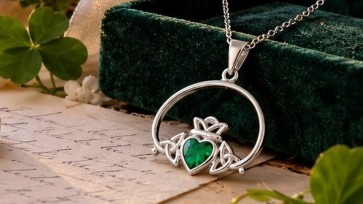
The simplest November piece in our collection pairs a golden stone with an old symbol of luck. The four-leaf clover is a longtime Irish good-luck charm, and this pendant, about 15mm by 15mm, is offered in twelve simulated birthstones. The November version carries a simulated citrine. Simulated means man-made, not mined, and that is why the price stays friendly.

Good Luck 4Leaf Clover November Birthstone Pendant
$89.99 · Sterling silver / simulated citrine
An 18-inch chain, a clover said to stand for faith, hope, love and good luck, and a golden stone for the November birthday. A good first birthstone piece for a daughter, a niece or a friend.
Shop the November clover pendantNovember Birthstone Rings: Claddagh Styles in Gold-Toned Stones
For a ring, the Claddagh is the Irish piece most families already know. We keep the full story of the Claddagh in its own place, so for that history see our Claddagh rings collection. Here the point is the stone. Two sterling silver Claddagh rings carry November colors.

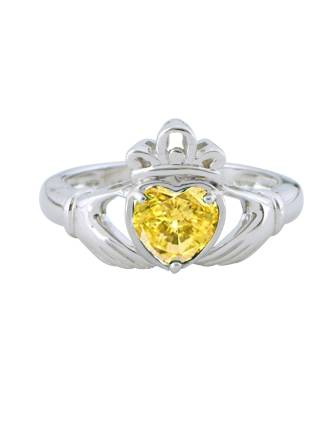
November Birthstone Claddagh Ring
$99.99 · Sterling silver / yellow cubic zirconia, 6mm heart
The entry-level November ring. Available in sizes 5 to 10, it suits a first birthstone ring, a teen, or an everyday Claddagh.
Shop the November Claddagh ring
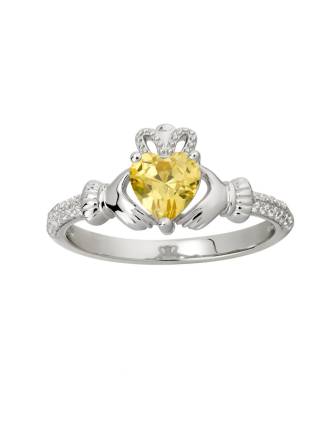
Claddagh Ring Birthstone Ring November Topaz and CZ
$149.99 · Irish hallmarked sterling silver / simulated topaz and clear CZ
The more detailed November ring, with a simulated topaz and clear cubic zirconia. A fuller piece for a milestone birthday or a Christmas gift.
Shop the topaz Claddagh ringNovember Birthstone Gifts: Choosing the Right Piece
November birthdays sit right before Thanksgiving, which falls on 26 November this year, and right after Samhain. That makes the stone a natural gift for the family gathering, and a thoughtful early Christmas present for someone born in the month. Here is how our three November pieces compare.
| Piece | Metal / stone | Best for | Price |
|---|---|---|---|
| Good Luck 4Leaf Clover November Birthstone Pendant | Sterling silver / simulated citrine | Daughters, nieces, first birthstone gift | $89.99 |
| November Birthstone Claddagh Ring | Sterling silver / yellow cubic zirconia | Everyday wear, teens, first Claddagh | $99.99 |
| Claddagh Ring Birthstone Ring November Topaz and CZ | Irish hallmarked sterling silver / simulated topaz and CZ | Milestone birthdays, Christmas gifts | $149.99 |
A few practical notes. All three pieces use simulated or cubic zirconia stones, not natural topaz or citrine. We say so on every page because it is true, and because it keeps the price within reach. If you want a true natural stone, ask the seller about its origin and treatment, since most citrine is heat-treated amethyst and most blue topaz is treated. Free standard shipping applies on US orders over $250. You can browse the whole November birthstone jewelry selection, or the wider birthstone jewelry and birthstones collection pages for other months.
Caring for Topaz and Citrine Jewelry
For natural stones, the GIA's guidance is specific. Topaz should avoid steam cleaning and ultrasonic cleaners. Use warm, soapy water, and keep it away from high heat or sudden temperature changes, which can cause internal breaks. Prolonged heat or sunlight may fade some yellow-to-brown stones. Citrine can be cleaned with warm, soapy water, and ultrasonic cleaning is usually fine, but steam is risky.
For sterling silver pieces with simulated stones like ours, the general habit is simple: wipe with a soft cloth, keep them dry, store them apart from other jewelry, and put them on after perfume and lotion. That is general jewelry care, not a statement from the product page.
Frequently Asked Questions About the November Birthstone Meaning
What is the meaning of the November birthstone?
The November birthstone meaning centers on warmth, joy and good fortune. Topaz and citrine are both golden stones, long linked in gem lore to strength, calm and cheer. These are traditional associations, not scientific facts. Our birthstone chart lists November as yellow topaz and citrine, meaning lightheartedness, joy and good fortune.
What is the spiritual meaning of the November birthstone?
In modern crystal and metaphysical circles, topaz is linked to clarity and confidence, and citrine to optimism and a steady mood. Both are called calming, sunny stones. This is belief, not evidence, and it is not medical advice. Older traditions credit topaz with strength and protection.
What does topaz symbolize as a November birthstone?
Topaz has symbolized strength and fire across many cultures. The ancient Greeks believed it gave strength, and Renaissance Europeans thought it broke spells and calmed anger. In India it was said to bring long life when worn over the heart. Pink-orange imperial topaz was reserved for the Russian royal family.
What does citrine symbolize as a November birthstone?
Citrine is yellow quartz, with a name believed to come from the French word for lemon. It symbolizes joy, warmth and optimism. Because it was long mistaken for topaz, people credited it with the same calming powers. Most citrine today comes from heat-treated amethyst, and it is the traditional 13th anniversary gem.
What is the November birthstone color meaning?
The color of the November birthstone runs from lemon yellow to deep golden orange. In most Western gem lore, that color stands for sunlight, cheer and abundance. It suits the month well, when daylight shortens and candles come out. Some topaz also appears in other colors, but yellow and gold are the classic November choice.
What is the November birthstone astrology sign?
Jewelers' charts commonly pair November with Scorpio, roughly 23 October to 21 November, and Sagittarius, roughly 22 November to 21 December. This is modern convention, not an ancient rule. Gem and sign pairings varied between lists, so choose the stone you love rather than treating astrology as a firm guide.
Is there Irish folklore about topaz or citrine?
We found no documented Irish or Celtic folklore about topaz or citrine, so we do not claim any. What Ireland does hold in November is Samhain on 1 November, All Souls on 2 November with candles in windows, and St. Martin's Eve on 10 and 11 November. A golden stone simply fits that season.
Is the November birthstone topaz or citrine?
Both. Topaz was the original November stone on the 1912 jewelers' list, and citrine was added in 1952. Modern US and UK charts list the two together, so you can choose either. Our November pendant uses a simulated citrine, and our topaz Claddagh ring uses a simulated topaz.
About the author
Jennifer Derrig is the founder and creative director of The Irish Jewelry Company, which she started in 2006. A FIT-trained jewelry designer and the author of The Heritage Brand: How to Build a Heritage Brand People Love, she designs pieces that carry Irish and Celtic heritage into everyday life.
Give the November birthday something golden.
Shop November birthstone jewelryKeep reading: December Birthstone Guide: Turquoise, Tanzanite, Blue Topaz & Zircon Meaning · The Cailleach: Ireland's Winter Goddess · Irish Christmas Gifts for Mom and Nana · The Wexford Carol · Shop Irish Christmas Gifts