
The Cailleach: Ireland's Winter Goddess and the Hag of Beara
Quick answer: The Cailleach is the ancient hag of Irish and Scottish folklore, a giant old woman who shapes mountains, raises storms, and rules the dark half of the year. In Ireland she is the Cailleach Bhéarra, the Hag of Beara, remembered in a medieval poem, a stone in west Cork, and the Hill of the Hag at Loughcrew. Brigid's spring follows her winter.
Drive the coast road out along the Beara Peninsula in November, when the light goes early and the Atlantic turns the color of slate. Past Eyeries, near the old church at Kilcatherine, a grey rock sits on the slope above Coulagh Bay. From the right angle it looks like a woman hunched against the wind, her face turned toward the sea. Coins wedged in its cracks glint in the last of the light.
The people of Beara will tell you who she is. She is the Cailleach, the Hag of Beara, older than the hills, because she made most of them. She has been waiting a very long time.
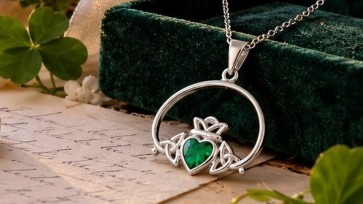
As the year tips toward its longest night, her story is worth telling. She is Ireland's winter queen, the old woman of the dark half of the year, and her shadow falls across some of the oldest monuments in Europe. We often think of her when we wear spirals and triple knots in December, like our Triskele Trinity CZ Pendant, a design that echoes the carved stones she is said to have scattered across the land.
What the Word Cailleach Means
In modern Irish and Scottish Gaelic, cailleach simply means old woman, or hag. The word is older and stranger than that. It comes from Old Irish caillech, the veiled one, from caille, a veil, which was itself one of the earliest Latin words to enter Irish, from pallium, a woollen cloak.
A veiled woman in early Christian Ireland could be a nun, and caillech could mean exactly that. It could also mean a widow, or simply a woman past her youth. The great hag of folklore wears all of those meanings at once: the woman who has outlived her husbands, the woman who took the veil in old age, and the shrouded figure of winter itself.
Her most famous Irish name is the Cailleach Bhéarra, the Hag of Beara, after the rugged peninsula shared by west Cork and south Kerry. In Scotland she is the Cailleach Bheurra, and on the Isle of Man she is the Caillagh. She turns up in landscape legends from Antrim to Kerry and from the Hebrides to Galloway.
The Hag of Beara Stone at Kilcatherine
Folklore gives two reasons why the Cailleach became the rock above Coulagh Bay. In one, she was turned to stone by a monk of the early church, sometimes as punishment for her quarrel with the new faith. In the other, she is the wife of Manannán mac Lir, the sea god, and she sits there still, watching the water for his return.
Either way, the stone is treated with respect. Visitors leave coins, ribbons, shells, and small trinkets in its crevices, a habit that keeps the old woman in good humor. It is a quiet place, with nothing to buy and only a small sign, and it is one of the most moving spots on the Wild Atlantic Way.
Beara is far from her only home. In County Cork, the great wedge tomb at Labbacallee near Glanworth, Leaba Caillí, the Hag's Bed, is said to be her grave. On Slieve Gullion in County Armagh, folklore places her house at the summit, and tells how she tricked Fionn mac Cumhaill into diving into the lake there, so that he came out an old man with hair as white as snow.
In the Schools' Collection, the folklore that Irish children gathered from their elders in the 1930s, one story from County Kerry tells of the Cailleach trying to tow part of Beara out to sea with a rope. The rope snapped, and the pieces she left behind are the islands you can still see off the coast.
The Lament of the Old Woman of Beare
The Cailleach also has one of the great poems of early Irish literature. The early Irish poem known in English as The Lament of the Old Woman of Beare is usually dated to around the 9th or 10th century. Its speaker is an old woman who once drank wine and mead with kings, and who now lives as a nun, wrapped in a veil, drinking whey-water among other old women.
Medieval notes attached to the poem give her the name Digdi, and other tellings call her Buí. They say she had seven periods of youth, outlived every husband she ever had, and that her grandchildren and great-grandchildren became whole peoples. She is not a monster here. She is a proud woman looking back on a long life, and grieving the youth she can't get back.
The German scholar Kuno Meyer translated the poem in 1899, and again in his Selections from Ancient Irish Poetry (1911). His version opens with the sea:
Ebb-tide to me as of the sea!
Old age causes me reproach.From The Lament of the Old Woman of Beare, translated by Kuno Meyer, 1911
The tide runs right through the poem. She compares her life to the flood and the ebb, and she envies an island in the ocean, because the tide always comes back to it. For her, no flood will follow:
O happy the isle of the great sea
Which the flood reaches after the ebb!Kuno Meyer, 1911
And later, in four words, the heart of the whole poem: "What was on flood / Is all on ebb." It is a poem about growing old, written more than a thousand years ago, and it still lands. Anyone who has sat with a grandmother as she talks about the dances she went to as a girl will recognize the voice.

Triskele Trinity CZ Pendant
$139.99
Three spirals turning around one bright center, like the turning of the tide and the year in the Cailleach's own story. The sparkle of the CZ makes it a December gift that catches the low winter light.
Shop the Triskele Trinity PendantLoughcrew and Sliabh na Caillí, the Hill of the Hag
About ninety minutes north-west of Dublin, in County Meath, a ridge of hills rises above the farmland near Oldcastle. Its Irish name is Sliabh na Caillí, the Hill of the Hag, and its summits are crowned with Neolithic passage tombs, the Loughcrew cairns.
Folklore explains them with a story. The Cailleach was striding across the country with her apron full of stones and dropped a load on each hilltop. In one telling she made a wager that she could drop stones on all three peaks. She managed the first two, missed the third, fell, and broke her neck. Her grave, the story says, lies there on the hill.
The Hag's Chair
The largest tomb on the eastern summit, Cairn T, dates to around 3300 BC, centuries older than the pyramids at Giza. Inside its chamber the stones are covered in carved spirals, flowers, and sun-like circles. Among the great kerbstones that ring the cairn, sits a huge block carved into a rough seat: the Hag's Chair.
At some later point a cross was cut into it. Archaeologists suggest the chair may have served as a ceremonial or inauguration seat in the early medieval period, or as a Mass rock during the Penal times, when Catholic Mass had to be said in secret in the open air. Either way, generations have sat in the Cailleach's chair and looked out across the midlands.
Cairn T is also aligned to the sun. At sunrise around the spring and autumn equinoxes, light enters the passage and falls on the decorated backstone of the chamber. Access to the chamber interior has been restricted at times for conservation, so check with the site before you plan a visit.
The Cailleach and the Dark Half of the Year
The old Irish year turned on two great hinges. Samhain, at the start of November, opened the dark half. Bealtaine, at the start of May, opened the bright half. Between them sat Imbolc, on February 1, when the first lambs came and the days began to lengthen in earnest.
In Scottish and Manx folklore, the Cailleach is the queen of that dark half. She takes up her rule at Samhain, washes her great plaid in the whirlpool of Corryvreckan until it comes out white as snow on the hills, and keeps the land frozen until spring. Her staff, some say, freezes the ground wherever she strikes it.
Beira, Queen of Winter
Many of today's popular images of the Cailleach come from Scotland, and specifically from one book. In his 1917 Wonder Tales from Scottish Myth and Legend, Donald A. Mackenzie retold her as Beira, Queen of Winter: a one-eyed giantess with white hair, dark blue skin, and rust-red teeth, who built the mountains by dropping rocks from her creel. Mackenzie's Beira is a literary retelling built on Highland folklore, and a vivid one, but she belongs to Scotland and to the 20th century.
The Imbolc weather test
Scottish and Manx folklore also tells how the Cailleach behaves on February 1. If she wants a long winter, she makes the day bright and dry so she can gather plenty of firewood. If the day is wet and stormy, she has overslept and will run out of wood, and spring is on its way. If you hear someone say that a foul Imbolc means an early spring, that is the Cailleach talking.
Brigid: The Spring That Follows the Cailleach
Where the Cailleach is winter, Brigid is the returning light. In Scottish folklore the two are paired directly: the Cailleach holds the land from Samhain to Bealtaine, and Brìde, Brigid, brings the green back. Some modern writers go further and describe them as a single goddess with two faces, the hag of winter and the maiden of spring. That is a modern interpretation, and a beautiful one, but the pairing of winter hag and spring Brigid is old in the folklore.
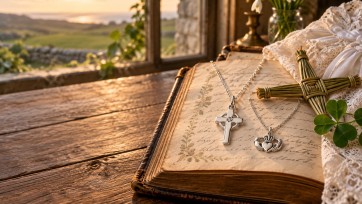
In Ireland, Brigid is above all St. Brigid of Kildare, patroness of Ireland alongside Patrick and Columba, whose feast is February 1. Since 2023, Ireland has marked her day with a national public holiday, the first named for a woman. On the eve of the feast, families weave St. Brigid's crosses from fresh rushes and hang them over the door to protect the house for the year.

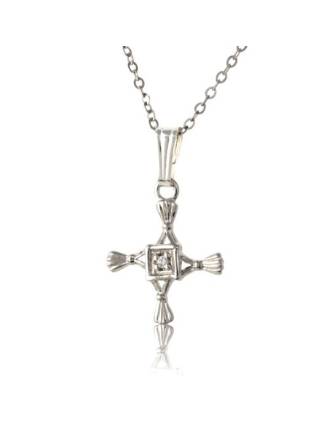
St. Brigid's Cross Pendant
$79.99
When the Cailleach's winter loosens its grip, Brigid's cross goes up over the door. This pendant carries that promise of spring, a fitting gift for anyone who finds the dark months long.
Shop the St. Brigid's Cross PendantFor more on Ireland's old gods and goddesses, from the Morrígan to the Dagda, see our guide to 12 Celtic gods and goddesses.
Spirals, Solstice, and the Cailleach's Stones
The Cailleach is the season's old woman, and the winter solstice is her deepest night. This year the solstice falls on Monday, December 21, 2026. That morning at Newgrange, in the Boyne Valley not far from Loughcrew, the rising sun will shine through a roof-box above the entrance and light the inner chamber for about seventeen minutes. Our post on Newgrange, the winter solstice and Celtic spirals tells that story in full.
The triple spiral carved inside Newgrange, about 5,000 years old, is one of the oldest symbols in Ireland. No one knows for certain what its makers meant by it. Modern interpretations read the turning spirals as the sun, the seasons, or the cycle of life, death, and return. That last reading fits the Cailleach's story: the year winds down into her winter and unwinds again into Brigid's spring.

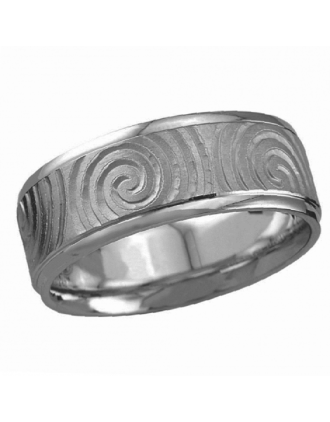
Newgrange Swirl Wedding Ring Sterling Silver Triskele
$499.99
Inspired by the spirals carved into Newgrange, this sterling silver band carries the oldest pattern in Ireland around the finger. For a winter wedding, or a solstice anniversary, it is hard to think of a better symbol.
Shop the Newgrange Swirl RingThe triskele lives on in Christian art too. The monks who made the Book of Kells around the year 800 filled its pages with triple spirals. Our guide to 12 Celtic symbols and their meanings traces how the spiral, the knot, and the cross passed from carved stone to vellum to silver.


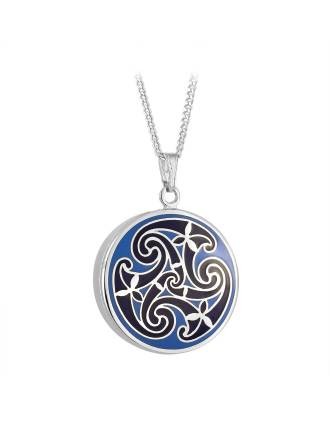
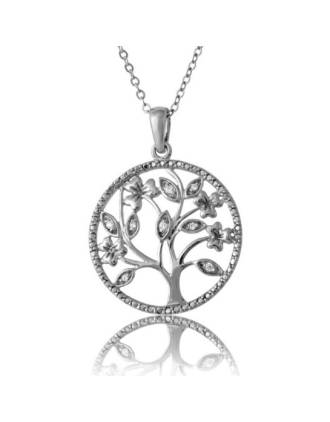
For a smaller gift, the Book of Kells Blue Triskele Necklace brings the manuscript spiral into a bright blue piece, and the Triskele Trinity CZ Earrings match our hero pendant. The Celtic Tree of Life Necklace is the gift for someone who loves the bare winter tree waiting for spring.
Honoring the Old Woman of Winter
You don't need to climb Loughcrew at dawn to keep the Cailleach's season. Notice the dark. Light a candle on the longest night. Tell the children the story of the apron full of stones. And when February 1 comes around, watch the weather, weave a rush cross, and thank the old woman for letting go.
Her poem ends with a woman who has seen everything and outlived nearly everyone. That is no small thing to honor. In many Irish families, the Cailleach is the grandmother who still sits at the head of the table at Christmas: the keeper of the stories, the one who remembers who married whom, and who will tell you, if you ask, what the winters were like when she was young. This year, give her something with a spiral in it.
Frequently Asked Questions About the Cailleach
Who is the Cailleach?
The Cailleach is the divine hag of Irish, Scottish, and Manx folklore, an ancient woman linked with winter, storms, and the shaping of the land. In Ireland she is best known as the Cailleach Bhéarra, the Hag of Beara, from the Beara Peninsula in west Cork. Tradition says she lived through seven youths.
What does the word cailleach mean?
Cailleach means old woman or hag in modern Irish and Scottish Gaelic. It comes from Old Irish caillech, the veiled one, from caille, a veil, a very early borrowing of the Latin pallium, a woollen cloak. The same word could also mean a nun, a woman who had taken the veil.
Where is the Hag of Beara stone?
The Hag of Beara stone stands near Kilcatherine on the Beara Peninsula in County Cork, above Coulagh Bay. Folklore says it is the Cailleach herself, turned to stone, still looking out to sea for her husband Manannán. Visitors leave coins and small trinkets on the rock.
Is the Cailleach connected to Brigid?
In Scottish folklore, the Cailleach rules the dark half of the year from Samhain to Bealtaine, and Brìde, or Brigid, rules the bright half. Some modern writers see them as two faces of one goddess. That pairing is folklore and modern interpretation, but Brigid's feast on February 1 does mark winter's turn in Ireland.
What is the Hag's Chair at Loughcrew?
The Hag's Chair is a large carved kerbstone at Cairn T on Sliabh na Caillí, the Hill of the Hag, at Loughcrew in County Meath. Cairn T dates to around 3300 BC. A cross was later carved into the seat, and the stone may have served as a Mass rock or an inauguration seat.
Was the Cailleach a goddess?
Folklore treats her as a supernatural ancestor and shaper of the land, and many writers call her a goddess of winter. The early Irish sources present her as the Old Woman of Beare, a figure of great age and royal memory. Calling her the Celtic winter goddess draws on that folklore and on modern interpretation together.
About the author
Jennifer Derrig is the founder and creative director of The Irish Jewelry Company, which she started in 2006. A FIT-trained jewelry designer and the author of The Heritage Brand: How to Build a Heritage Brand People Love, she designs pieces that carry Irish heritage into everyday life.
Carry Ireland's ancient spirals through the dark half of the year
Shop the collectionKeep reading: A Guide to 12 Infamous Celtic Gods and Goddesses · Newgrange, the Winter Solstice and Celtic Spirals · 12 Celtic Symbols and Their Meanings Explained · Shop Irish necklaces