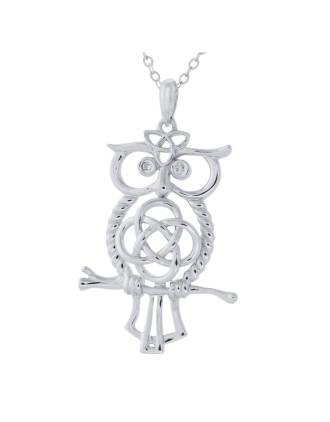

The owl symbolizes wisdom, transformation, intuition, and protection against deception. In Celtic mythology, the owl is the companion of Cailleach, the winter Hag Goddess, and its Scottish Gaelic name — cailleach-oidhche, "white old woman of the night" — reflects that sacred bond. The Celts believed the owl guided souls through the Underworld, saw truth through any disguise, and carried messages between the mortal world and the Otherworld. Across nearly every world mythology, from Athena's owl in Greece to the Celtic night-hunter, the owl stands for knowledge that sees in the dark.
What Does It Mean When You See an Owl?
In Celtic tradition, seeing an owl — especially at dusk or on a threshold night like Samhain — was understood as a message from the Otherworld. Because the owl served Cailleach, the goddess who ruled the dark half of the year, its appearance often marked a moment of transition: the end of one season of life and the beginning of another. Far from being purely an omen of death, as later superstition claimed, the Celtic owl signaled transformation — a call to trust your own inner sight during a time of change.
The owl's reputation as an unmasker of deception also shaped this belief. With eyes that pierce darkness and flight that makes no sound, the owl was thought to perceive what others concealed. To see one was a reminder to look beneath the surface of a situation — or a warning that someone nearby was not what they appeared to be.
Owl Meaning in World Mythology
The Celtic owl belongs to a global family of owl symbolism. In Greek mythology the owl was sacred to Athena, goddess of wisdom, and a "little owl" accompanied her everywhere — the origin of the phrase "wise as an owl." In Norse tradition, night birds were tied to the seeress and to hidden knowledge. Native American traditions vary by nation: some honor the owl as a guardian of sacred knowledge, while others treat it as a messenger between worlds. In nearly every culture, the constant threads are the same ones the Celts wove into their lore — wisdom, night vision, transition, and truth.


The word “cailleach” in the Scottish-Gaelic means old woman!, Owl in Gaelic is “cauileach-oidhche” , believe it or not it means “night-cockerel” or “white old woman of the night.” Because the owl was most often associated with the Crone aspect of the Celtic Hag Goddess “Cailleach”. The owl is often a guide to and through the Underworld, a creature of keen sight in darkness, and a silent and swift hunter. Celtic folklore says the wise owl can give you wisdom by helping unmask those who would deceive you or take advantage of you. “Hoo” knew?
What does the owl signify in Celtic culture?
The owl is a creature that has sharp vision even in the dark, a hunter that is stealthy and quick, and it often acts as a guide to and through the Underworld. Celtic legend has it that the wise owl may bestow insight upon its human companion by revealing the identities of people who would want to trick them or take advantage of them.
Is the owl an unusual sight in Ireland?
The population of this species has been decreasing over the past few decades, and as a result, its home range has shrunk to include just parts of the southwest and the midlands of Ireland. It is estimated that the population of barn owls has decreased by more than fifty percent over the course of the previous quarter century, and the IUCN Red List of Ireland has now included it as a species of concern.
What kind of bird cries out in the night in Ireland?
Because they are nocturnal and native to Ireland, barn owls are difficult to spot because they prefer the cover of darkness. This contributes to the mystique surrounding these birds. Their haunting cries are what gave rise to the myth of the banshee, a female ghost who was said to have been able to predict a person's impending death by howling and howling at night.
Is it considered fortunate to spot an owl?
Owls are often seen as symbols of tremendous knowledge and insight, and they may also provide direction. These birds may serve as a warning of a threat that is surmountable, as well as a portent of prosperity or positive change. In certain societies, owls are believed to be divine messengers or even to act as intermediaries between this world and the next.
What is another Celtic word for owl?
Our Celtic Owl pendant and Celtic Owl earrings with diamond eyes are fierce creatures, wise and omniscient, not to mention ultra-trendy and stylish. These fashionable nocturnal birds are a ‘hoot’ to wear day or night of course.
Frequently Asked Questions About Owl Symbolism
What does an owl symbolize?
The owl symbolizes wisdom, intuition, transformation, and protection against deception. In Celtic mythology it serves the goddess Cailleach and guides souls through darkness. In Greek mythology it accompanies Athena, goddess of wisdom. Across cultures, the owl represents knowledge that can see what remains hidden from others.
What does the owl mean in Celtic mythology?
In Celtic mythology the owl is the sacred companion of Cailleach, the Hag Goddess of winter, death, and transformation. Its Gaelic name, cailleach-oidhche, means "white old woman of the night." The Celts believed the owl guided souls through the Underworld and could unmask deception with its penetrating night vision.
What does it mean when you see an owl?
In Celtic tradition, seeing an owl signals a period of transition or transformation and a call to trust your inner wisdom. Because the owl was believed to perceive hidden truths, its appearance was also read as a prompt to look beneath the surface of a situation or a warning about concealed intentions nearby.
Is seeing an owl good luck or bad luck?
It depends on the tradition. Celtic lore treated the owl primarily as a wise guide and protector, making its appearance meaningful rather than unlucky. Later European superstition cast the owl as a death omen, but the older Celtic view emphasized transformation — the end of one phase and the start of another — rather than misfortune.
What is cailleach-oidhche?
Cailleach-oidhche is the Scottish Gaelic word for owl, translating to "night-cockerel" or "white old woman of the night." The name links the owl to Cailleach, the Celtic Hag Goddess who rules winter and the dark half of the year, and reflects the owl's role as her messenger and companion in Celtic folklore.
Why is the owl associated with wisdom?
The owl's association with wisdom comes from its remarkable abilities: seeing in near-total darkness, rotating its head to observe in all directions, and flying in complete silence. Ancient cultures interpreted these traits as signs of supernatural insight. The Greek goddess Athena and the Celtic goddess Cailleach both adopted the owl, cementing its status as wisdom's emblem.