
The Wexford Carol: The Story of Ireland's Oldest Christmas Carol
Quick answer: The Wexford Carol is a traditional Irish nativity carol from Enniscorthy, County Wexford, known in Irish as Carúl Loch Garman. William Grattan Flood, organist at St. Aidan's Cathedral, wrote it down from a local singer and sent it to The Oxford Book of Carols, which printed it in 1928. Its true age is unknown. Tradition calls it medieval; scholars suggest the 15th or 16th century.
The light goes early in Enniscorthy in late December. By half four the River Slaney has turned the color of pewter, Vinegar Hill is a dark shoulder above the town, and the windows of St. Aidan's Cathedral start to glow. Somewhere inside, a choir is warming up. Then a single voice begins, slow and plain: "Good people all, this Christmas time..."
That is the Wexford Carol, and it may be the oldest Christmas song still sung in Ireland. Nobody knows who wrote it. Nobody can say for certain when. What we do know is that it survived for generations in the mouths of ordinary Wexford people, was nearly lost, and was saved by a cathedral organist with a notebook. Today it is sung in parish churches from Kilmore to Boston, recorded by choirs and folk singers, and played on Irish radio every Christmas week.
Its melody has the shape of an old harp air, the kind that rises and falls like a sigh. That is part of why we love it so much in our family, and why the harp sits at the center of the Christmas gifts we choose for the music lovers we know. The Irish Harp Pendant carries the same instrument that gave Ireland its music, its coat of arms and, in a quiet way, this carol.
What Is the Wexford Carol?
The Wexford Carol is a nativity carol. It tells the Christmas story in the order a child would tell it: God sends His Son, Mary and Joseph find no room at the inn, the Child is born in a stable, angels appear to shepherds, and wise men follow a star. It does not dwell on doctrine. It reads like a story told by the fire.
It goes by several names. In English it is the Wexford Carol or the Enniscorthy Carol. Many people simply know it by its first line, "Good people all, this Christmas time." In Irish it is Carúl Loch Garman, Loch Garman being the Irish name for Wexford. It is also sometimes listed as Carúl Inis Córthaidh, after Enniscorthy itself.
The tune is a traditional Irish air in a steady four-line meter. Musicians call it long metre: eight syllables to each line. That simple frame is part of its strength. A congregation can pick it up on the second verse. A lone singer can carry it without accompaniment. A harper can play it as a slow air and it loses nothing.
The first verse
The words are traditional and long out of copyright. Here is the opening verse as it appeared in The Oxford Book of Carols:
Good people all, this Christmas time,
Consider well and bear in mind
What our good God for us has done
In sending His beloved Son.
The verses that follow ask the listener to pray with Mary on Christmas Day, describe the birth in Bethlehem, the closed doors of the inn and the ox and ass in the stable, then turn to the shepherds keeping watch and the angel's message. The final verses bring the wise men from the East to kneel before the Child.
Where It Comes From: Enniscorthy and the Slaney
Enniscorthy is a market town on the River Slaney, about twenty miles north of Wexford town. It is best known to most Irish people for Vinegar Hill, where the United Irishmen made their last great stand in the Rising of 1798. Above the town stands a Norman castle, and on the hill to the east stands St. Aidan's Cathedral, designed by Augustus Welby Pugin in the 1840s.
That cathedral matters to this story. In the late 1800s its organist and musical director was a man named William Henry Grattan Flood. Flood was a scholar as well as a musician. He wrote a history of Irish music and a history of the Diocese of Ferns, and he spent years gathering tunes and songs from the people of the county. He lived in Enniscorthy from 1895 until his death in 1928.
Somewhere in Wexford, Flood heard a local singer perform a Christmas carol he had never seen in print. He wrote it down. Later he sent it to the editors of a new carol collection being prepared in England: Percy Dearmer, Ralph Vaughan Williams and Martin Shaw. They included it in The Oxford Book of Carols, published in 1928, the same year Flood died. It appeared there as carol number 14.
From that one page, the carol travelled. Choirs who had never been to Ireland learned it. Organists in America and Australia added it to their Christmas services. A song that had lived for centuries in a small corner of Leinster became one of the best known Irish carols in the world.
An honest note on who first wrote it down
Flood is credited with discovering the carol, and that is how most histories tell it. Scholars have pointed out a few wrinkles. The editors of The New Oxford Book of Carols noted that the text appears to be English in origin, with several verses close to those in an English collection of old Christmas carols. They suggested the Irish-language version is a translation of the English words rather than the other way round. None of this takes anything from the carol. Wexford was a county where English, Irish and the old Yola dialect of the Norman settlers lived side by side, and its songs show it.
How Old Is the Wexford Carol? Legend and Evidence
You will often read that the Wexford Carol dates from the 12th century. Tradition holds that it is one of the oldest carols in Europe, and many Irish writers repeat the claim with pride. We like the story too. But we would be doing you a disservice if we told it as fact.
There is no 12th-century manuscript of the carol. The earliest secure record is Flood's transcription in the early 20th century. Musicologists who have studied the words and the tune tend to place it later, most often in the 15th or 16th century. Some argue for an earlier medieval origin; others think the words took their present shape later still. The fair answer is that its age is uncertain, and that it is old.
What is not in doubt is that County Wexford had a living tradition of Christmas carol singing long before Flood picked up his pen. And that tradition has a name.
The Kilmore Carols and the Wexford Carol Tradition
Drive south from Wexford town toward the coast and you reach Kilmore, a village a short way inland from the fishing harbour at Kilmore Quay. Every Christmas, in St. Mary's Church, six local men stand together and sing a cycle of carols that has been handed down in the parish for more than two and a half centuries. One of the six is always a member of the Devereux family. Traditionally they divide into two groups of three and alternate the verses.
These are the Kilmore Carols. There are thirteen in the cycle, though usually only eight are sung in any one season, spread across the Twelve Days of Christmas. The custom is said to have started around 1751, when a priest named Fr. Peter Devereux introduced carol singing at Kilmore. Tradition credits a relative, Fr. William Devereux, parish priest of Piercetown from 1730 to 1771, with gathering the carols into a manuscript he called A New Garland, around 1728.
Bishop Luke Waddinge and "A Smale Garland"
Some of those carols are older still. In 1684, the Catholic Bishop of Ferns, Luke Waddinge, published a small book of verse at Ghent in Flanders. It is usually remembered as A Small Garland of Pious and Godly Songs. Waddinge came from an Anglo-Norman Wexford family that had lost its lands in the Cromwellian confiscations. He was educated in Paris, and he wrote for a people who could not always worship openly.
His Garland included eleven Christmas songs. Three of the Kilmore Carols can be traced to it, and two of Waddinge's songs are still sung in Kilmore today. Picture it: verses printed in Flanders in the reign of Charles II, carried home to a diocese where Mass was often said in secret, and still sung every Christmas by six men in a village church near the sea.
The Wexford Carol is often linked to this tradition, and some writers attribute it to Waddinge himself. That link is not proven. But it belongs to the same soil: a county that kept its Christmas songs alive through penal times, emigration and change, one generation teaching the next.
The Harp, the Air and the Music of an Irish Christmas
Listen to the Wexford Carol played on a harp and you hear where it lives. The melody moves the way the old harp airs move, unhurried, with room for the strings to ring between phrases. Ireland is the only country in the world with a musical instrument as its national emblem. The harp is on our coins, our passports and the seal of the President. The oldest surviving Gaelic harp, often called the Brian Boru harp, is kept in the Long Room at Trinity College Dublin, and it is the model for the harp on the state's coat of arms.
For centuries the harpers were the keepers of Irish music. They travelled from house to house, playing for families who fed and sheltered them. Turlough O'Carolan, the blind harper born in 1670, composed tunes that are still played at Christmas sessions in pubs across the country. When the Belfast Harp Festival of 1792 gathered the last of the old harpers together, a young organist named Edward Bunting wrote down their tunes. More than a century later, Grattan Flood would do the same for one Wexford carol.
So when we think of the Wexford Carol, we think of the harp. It is the instrument of memory in Ireland. It says that a song, once learned, can outlast the people who first sang it.

Irish Harp Pendant
$129.99
For the singer in the family, the one who starts the carols when everyone else is still finding the page. The harp is Ireland's oldest musical symbol, and this pendant lets her carry it close all winter.
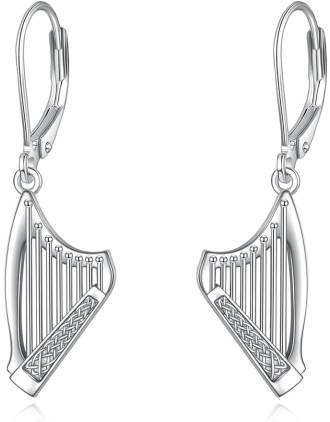
Shop the Harp PendantMusic runs in families the way carols run in parishes. If there is a fiddler, a choir member or a piano teacher on your list this year, a harp piece says something words can't. These two are favorites with our customers who sing in church choirs at Christmas.


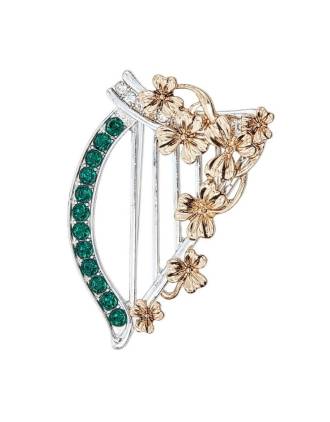
A brooch is an old Irish form in its own right. Pinned to a wool coat for Midnight Mass, the harp brooch is the kind of small, steady gift that gets worn every Christmas Eve for decades.
Faith at the Heart of the Carol: The Celtic Cross
It is easy to love the Wexford Carol for its tune and forget what it says. But this is a song of faith, sung by people who held on to that faith when it cost them. The Kilmore singers stand in a church. Bishop Waddinge wrote for a persecuted flock. Flood heard the carol from people who sang it as a prayer, not a performance.
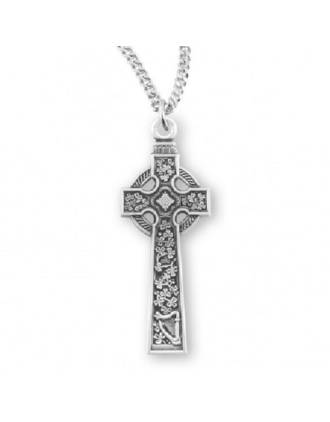
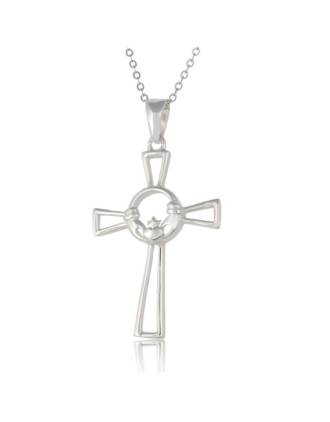
The Celtic cross carries the same quiet devotion. Its ring, joining the four arms, has been read for centuries as a sign of eternity, of God's love without beginning or end. The great high crosses of Ireland, at Monasterboice, Clonmacnoise and Moone, were carved with Bible scenes so that people who could not read could still learn the Christmas story. In that sense they did in stone what the Wexford Carol does in song. You can read more in our guide to the meaning of the Celtic cross.

Irish Harp Cross Necklace
$119.99
The Wexford Carol in one piece of jewelry: the harp for its music and the cross for its faith. A fitting gift for a parish choir member or a grandmother who still knows every verse by heart.
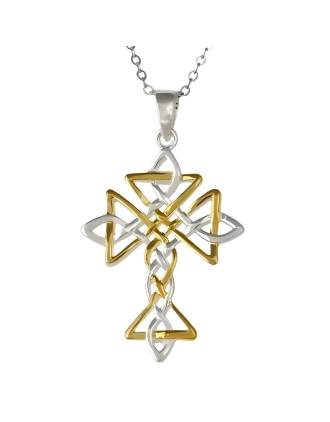
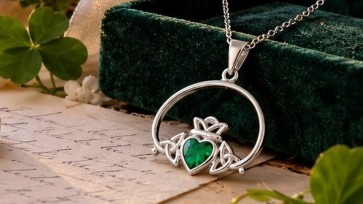
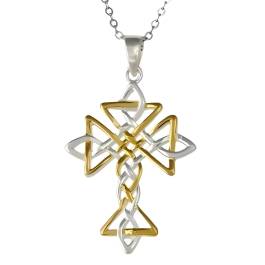
Shop the Harp CrossFor those who want the cross on its own, two pieces stand out. The Celtic knot cross weaves an unbroken line through the arms, a reminder that faith passed hand to hand never really ends. The Claddagh cross joins the hands, heart and crown of the Claddagh to the cross, love and loyalty held inside faith. Both make thoughtful Christmas gifts for a confirmation sponsor, a godmother or a mother who keeps the family going to Mass.

Recordings, Choirs and Kitchen Sing-Songs
Since its 1928 printing, the Wexford Carol has been recorded more times than anyone could easily count. Julie Andrews sang it in the 1960s. Loreena McKennitt recorded it in 1987. Nanci Griffith sang it with The Chieftains, and it appeared on their Christmas album The Bells of Dublin in 1991. John Rutter recorded it with the Cambridge Singers. Celtic Woman have sung it on more than one Christmas album.
One of the best known versions came in 2008, when cellist Yo-Yo Ma and bluegrass singer Alison Krauss recorded it together for the album Songs of Joy & Peace. In 2014 the Irish singer Caitríona O'Leary released a full album, The Wexford Carols, built around the old Wexford repertoire, with guest singers including Tom Jones and Rosanne Cash. It brought Waddinge's 17th-century songs to a whole new audience.
But the carol's real life is still local. It is sung at carol services in Enniscorthy and Wexford town, at school concerts in December, and around kitchen tables when the dinner plates are cleared and someone's uncle is asked for "the old one." In Irish-American parishes from Boston to Chicago, it has become a fixture of Christmas Eve, sung by grandchildren of emigrants who may never have seen the Slaney.
How to bring the Wexford Carol into your own Christmas
- Learn the first verse together. It is four lines. Children can manage it in an evening, and it makes a lovely grace before Christmas dinner.
- Light the candle first. Pair the carol with the old custom of the candle in the window on Christmas Eve, lit by the youngest in the house.
- Find a harp version. Play an instrumental recording during the quiet hour after Mass. The air carries the whole season in it.
- Tell the story behind it. Share how a cathedral organist in Enniscorthy wrote it down so it would not be lost. Children love to know that a song was nearly forgotten.
- Write down your own family's songs. Do what Flood did. Ask the oldest person at your table what they sang at Christmas as a child, and record it before it slips away.
Why This Old Carol Still Matters
Every family has something like the Wexford Carol. A recipe. A blessing. A song only Nana knows all the words to. These things survive because someone cares enough to pass them on, and they are lost when no one does. The Wexford Carol came within a whisker of being lost. It lasted because a singer in Wexford remembered it, and because an organist thought it worth writing down.
That is what heritage jewelry is for, too. A harp pendant given at Christmas becomes the harp pendant worn to every carol service after. A Claddagh cross becomes the cross a daughter inherits. The object holds the memory so the memory can be handed on. If you'd like more Christmas words to pair with your gift card this year, our collection of Irish Christmas blessings has a verse for every person on your list.
If you are ordering a gift for Christmas morning, please check our holiday cut-off dates before you place your order: In-stock pieces ship in one business day. See our holiday shipping deadlines for Christmas delivery dates by shipping method..
Frequently Asked Questions About the Wexford Carol
How old is the Wexford Carol?
No one knows for certain. Tradition often places the Wexford Carol in the 12th century, but there is no manuscript to prove it. Most music historians suggest it took shape in the 15th or 16th century. The earliest written version is William Grattan Flood's early 20th-century transcription from a Wexford singer.
What is the Wexford Carol called in Irish?
In Irish it is called Carúl Loch Garman, which means the Wexford Carol, since Loch Garman is the Irish name for Wexford. It is also sometimes called Carúl Inis Córthaidh, the Enniscorthy Carol, after the town where it was written down. Many English speakers know it by its first line.
Who wrote down the Wexford Carol?
William Henry Grattan Flood, the organist and musical director of St. Aidan's Cathedral in Enniscorthy, transcribed it from a local singer. He sent it to the editors of The Oxford Book of Carols, Percy Dearmer, Ralph Vaughan Williams and Martin Shaw, who published it in 1928.
What are the Kilmore Carols?
The Kilmore Carols are a cycle of thirteen Christmas carols sung each year during the Twelve Days of Christmas in St. Mary's Church, Kilmore, County Wexford. Six local men, always including a Devereux, sing them. Some of the carols trace back to Bishop Luke Waddinge's 1684 book of Christmas songs.
Is the Wexford Carol in the public domain?
Yes. The traditional words and melody are centuries old and free for anyone to sing, print or perform. Individual modern arrangements and recordings, such as choral settings or studio versions, are protected separately, so check before reproducing a specific arrangement in a church bulletin or concert program.
What jewelry goes with the Wexford Carol as a Christmas gift?
The Irish harp is the natural match, since it is the instrument of Irish music and the national emblem. A harp pendant, harp earrings or a harp brooch suits singers and musicians. For a gift that honors the carol's faith, a Celtic cross or Claddagh cross necklace is a lovely choice.
About the author
Jennifer Derrig is the founder and creative director of The Irish Jewelry Company, which she started in 2006. A FIT-trained jewelry designer and the author of The Heritage Brand: How to Build a Heritage Brand People Love, she designs pieces that carry Irish heritage into everyday life.
Give the music of an Irish Christmas this year
Shop the collectionKeep reading: Christmas in Ireland: A Story of Irish Christmas Tradition · Irish Christmas Blessings · Merry Christmas in Irish: Nollaig Shona · Shop Celtic crosses