The founder of The Irish Jewelry Company wrote a book about the real reason heritage brands create lifelong customers — and why it matters to every Irish American who has ever reached for a Claddagh ring.
I've been selling Irish jewelry since 2006. Over twenty years, tens of thousands of orders, and more conversations with customers than I could ever count — and I can tell you this with complete confidence: almost nobody buys a Claddagh ring because they need a ring.
They buy it because they need to feel Irish.
That distinction — between buying a product and buying a feeling of belonging — is the insight at the heart of my new book, The Heritage Brand: How to Build a Heritage Brand People Love. And while the book is written for entrepreneurs and business owners, the truth inside it explains something that every Irish American already feels but might never have had the words for: why a piece of jewelry can feel like coming home.
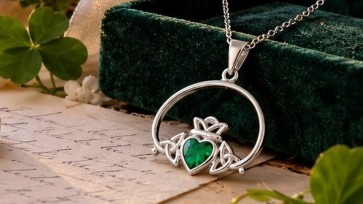
The Claddagh Ring Is Not Just a Ring
She walks into the shop — or finds us online at two in the morning while the rest of the house is asleep. She's third-generation Irish American. Maybe she's never been to Ireland. Her grandmother's brogue has softened across three generations into something barely there, a rhythm more than an accent. She doesn't know the words to Danny Boy past the first verse.
But she knows what a Claddagh means. Her mother told her. Her grandmother showed her. And something in her — something that economics can't quite measure — needs to hold onto that thread.
She buys the ring. She puts it on her right hand, heart facing out, the way you wear it when you're not yet spoken for. She may not be entirely sure of the etiquette. She doesn't care. What she cares about is this: for the first time in a long time, she belongs somewhere specific. She belongs to something older than her, larger than her, and entirely hers.
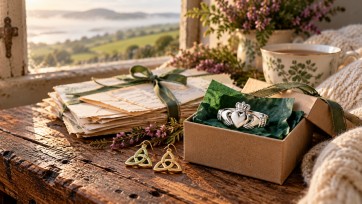
That ring is not jewelry. That ring is a passport.
I've watched this happen thousands of times. What I didn't understand for most of those years was why — the actual psychology and neuroscience behind what I was witnessing. Writing The Heritage Brand gave me the language for something I had only ever felt.
What I Learned After 20 Years
When I started The Irish Jewelry Company in 2006, I thought I was selling beautiful things. I sourced the craftsmanship, sweated over the photography, wrote the product descriptions with care. I was proud of what I made and what I sold.
What I didn't understand — not fully, not yet — was that my customers weren't shopping. They were searching.
They were searching for a way to express something they couldn't always put into words: I come from somewhere. My roots matter. This culture is mine, even if I've never set foot on Irish soil. Even if I'm mostly just Irish on St. Patrick's Day and all the way Irish in my heart.
The research I dug into while writing The Heritage Brand confirmed what I had observed behind the counter and in my inbox for two decades. There's a well-established body of work in economics and psychology showing that when a product is connected to a person's sense of cultural identity, it stops being a product in the ordinary sense. It becomes something closer to a symbol — and people will pay premium prices for symbols. They'll come back for them again and again. They'll tell their sisters and their daughters and their friends from book club.
They don't just become customers. They become members of something.
The 35 Million People Nobody Is Talking To
There are approximately 35 million Irish Americans in the United States. That is more than six times the population of Ireland itself. It is one of the largest, most culturally engaged diaspora communities in the world — and it is deeply, durably hungry for connection to its heritage.
These are not casual shoppers. They are people who drive two hours to a Celtic festival. Who save Irish linen tablecloths from their grandmothers' houses when everything else gets sold. Who light candles on St. Brigid's feast day even though they couldn't tell you exactly why. Who cry at Celtic music in airport terminals because something in the sound reaches them in a place beyond explanation.
They are not looking for a transaction. They are looking for someone who understands them.
That is the opportunity hiding in plain sight for every Irish brand, every Celtic artisan, every heritage business rooted in this culture. Most businesses try to reach these customers with discounts and promotions and better photography. What the research shows — and what I've lived — is that none of that is what moves the needle. What moves the needle is belonging. Specifically: the feeling that this brand gets me. This brand sees my heritage and honors it. I belong here.
Why Some Irish Brands Create Lifelong Loyalty — And Others Don't
I've watched Irish brands come and go over the past twenty years. I've seen beautiful products fail to find their audience, and I've seen simpler ones build fierce, faithful communities. The difference was rarely the product. It was almost always the belonging.
The brands that create lifelong loyalty — the ones whose customers return year after year, who give as gifts, who introduce their children to the brand as if initiating them into something meaningful — those brands do something specific. They don't just sell Irish things. They honor Irish identity. They tell a story. They create a place where being Irish, or feeling Irish, or longing to be Irish, is not a quirk but a welcome.
There's a difference between a shop that carries Irish goods and a brand that belongs to the Irish community. The difference is felt immediately, even if it's hard to articulate. It's in the language, the story, the way the brand speaks about heritage — not as a selling point but as a calling.
The Heritage Brand gets into the specific psychology and strategy behind this — the neuroscience of why identity-driven purchasing feels different from ordinary shopping, the economic research on why heritage commands premium prices, the framework for building the kind of brand loyalty that outlasts trends and algorithms and even, sometimes, the founder.
I deliberately kept the deeper frameworks inside the book, because they deserve the full treatment — and because a business book is meant to be worked through, not summarized. But I will tell you this much: once you understand what's actually happening when someone buys a piece of Irish heritage jewelry, you cannot unsee it. And that understanding changes everything about how you build a brand.
Why I Wrote This Book
I wrote The Heritage Brand because I needed it twenty years ago and it didn't exist.
I was a jewelry designer who had trained at the Fashion Institute of Technology in New York, built two heritage jewelry companies from nothing, and learned most of what I know the hard way — through customers, through mistakes, through watching what landed and what didn't. Through the Irish gift shop I loved that closed during COVID, and the grief of that, and the understanding that grief itself told me something important about what we'd built.
We hadn't just run a shop. We had created a place where people felt something. And when it closed, they felt its absence.
That's not marketing. That's belonging. And it can be built deliberately, by any heritage brand willing to do the work.
If you run an Irish business — whether you sell jewelry, ceramics, textiles, food, music, or any other piece of this culture — this book is for you. If you buy from Irish brands because something in you reaches toward your roots every time you do, this book will show you exactly why, and it might just change how you think about the purchases that have always felt like more than purchases.
By Jennifer Derrig — Founder, The Irish Jewelry Company
Available now in paperback and Kindle on Amazon.
Get your copy → amazon.com
Frequently Asked Questions
What is The Heritage Brand book about?
The Heritage Brand: How to Build a Heritage Brand People Love is a business book for cultural entrepreneurs — Irish, Italian, Celtic, and other heritage brand owners whose products are rooted in cultural identity. It explores the psychology of why people buy from heritage brands, the neuroscience of identity-driven purchasing, and the strategy for building a brand that creates real loyalty — not just repeat transactions.
Who is Jennifer Derrig?
Jennifer Derrig is the founder of The Irish Jewelry Company (est. 2006) and The Italian Jewelry Company, a classically trained jewelry designer (Fashion Institute of Technology, NYC), and an award-winning small business entrepreneur. She has spent over two decades building heritage jewelry brands rooted in Irish and Italian culture and lives on Long Island, New York.
Why do Irish Americans buy Irish jewelry?
The research is clear: it's not about the object — it's about the identity. Irish Americans buy Irish jewelry to feel connected to their heritage, their family history, and a cultural community larger than themselves. A Claddagh ring or Celtic knot pendant is a physical expression of belonging. The Heritage Brand explains the neuroscience and psychology behind this in full detail.
Is this book only for business owners?
The book is written for cultural entrepreneurs and heritage brand owners — but anyone curious about why certain brands inspire fierce loyalty (and why buying Irish, Italian, or Celtic products feels different from ordinary shopping) will find it illuminating. Customers of heritage brands often say it helped them understand their own purchasing instincts.
Where can I buy The Heritage Brand?
The book is available on Amazon in both paperback and Kindle. Find it here.
Jennifer Derrig is the founder and creative director of The Irish Jewelry Company and The Italian Jewelry Company. A classically trained jewelry designer and FIT alumna, Jennifer has spent more than two decades honoring cultural heritage through design — and helping other entrepreneurs do the same. The Heritage Brand is her debut business book. Learn more at jenniferderrig.com.