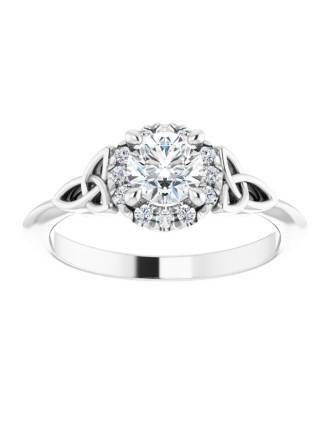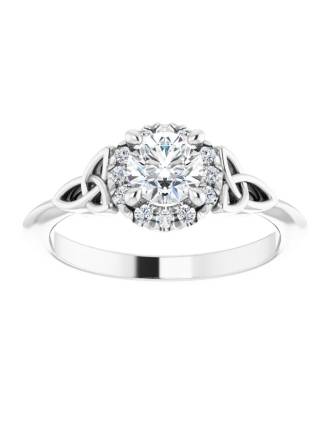
Celtic Knot Wedding Rings
Celtic Knot Wedding Rings and Wedding Bands
Celtic knot wedding rings are wedding bands patterned with interlaced knotwork drawn as a single unbroken line with no beginning and no end, which is why the design has stood for love without end for well over a thousand years. The Irish Jewelry Company carries 70 Celtic knot wedding rings in sterling silver, 10K and 14K yellow, white and rose gold, platinum, tungsten and stainless steel, priced from $39.99 to $4,799.99. Nearly every design is cut in both men's and women's widths, so couples wear genuinely matching Celtic knot wedding bands rather than two rings that only loosely resemble one another.
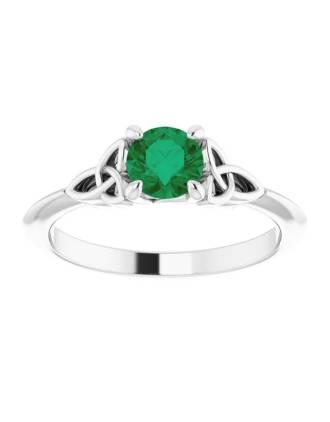
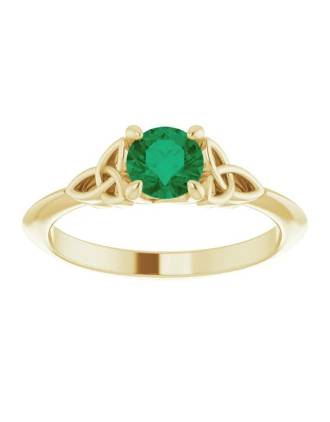
Interlaced knotwork of the kind carved into these rings appears in Insular manuscripts and metalwork from around the seventh century AD, reaching its most elaborate expression in the Book of Kells, held today at Trinity College Dublin. Earlier Celtic La Tène art, from roughly 500 BC, favoured spirals and triskeles rather than woven interlace. The patterns on our Celtic knot wedding rings draw directly from that later manuscript tradition, and each family of designs carries its own reading. The eternity knot loops continuously as a symbol of a bond without end. The lovers knot binds two separate strands into one unbroken form. The trinity knot, or triquetra, sets three interwoven arcs within a single line.
Metal choice shapes both the look of the knotwork and the life of the ring. Sterling silver takes a crisp, deeply cut pattern and is the most affordable way into a hand-finished Celtic knot wedding band, starting at $99.99. Two-tone silver and 10K gold designs raise the knotwork in contrasting metal so the pattern reads from across a room. Solid 10K and 14K gold bands run roughly $1,499.99 to $3,899.99 and hold their detail over decades of daily wear, while platinum designs begin at $3,499.99 and are the densest and most scratch-resistant of the precious metals. Tungsten and stainless steel Celtic knot wedding rings, from $39.99, suit anyone who works with their hands and needs a band that will not bend or scratch.
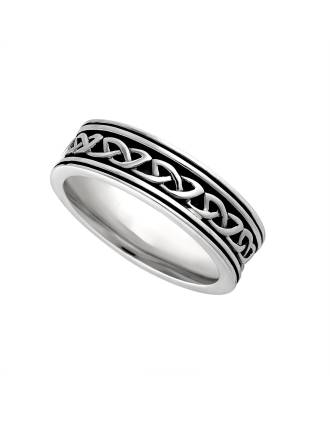
Finish matters as much as metal. Oxidized Celtic knot wedding bands are darkened in the recesses of the pattern so the interlace stands out in sharp relief. Embossed designs raise the knotwork above the surface of the band. Milgrain edging adds a fine beaded border along the rim. Comfort fit bands are domed on the inner surface so the ring passes the knuckle easily and spreads pressure across the finger instead of gripping at the edges, which matters on a ring worn every day for decades. Every piece is designed by Jennifer Derrig, a Fashion Institute of Technology graduate who founded The Irish Jewelry Company in 2006, and ships in signature gift packaging with free standard US shipping on orders over $250.
Celtic Knot Wedding Ring Questions
What does a Celtic knot wedding ring mean?
A Celtic knot wedding ring carries an interlaced pattern drawn in one continuous line with no beginning and no end, read as a symbol of eternal love and unbroken commitment. Specific knots narrow the meaning: the eternity knot for a bond without end, the lovers knot for two lives joined into one, and the trinity knot for the union of three.
What is the difference between a Celtic knot wedding ring and a Claddagh ring?
A Celtic knot wedding ring is patterned with woven interlace and is worn as a wedding band. A Claddagh ring shows two hands holding a crowned heart, standing for love, loyalty and friendship, and is worn as a friendship, promise, engagement or wedding ring depending on which hand and direction it faces. Some Irish wedding bands combine both designs.
Which metal is best for a Celtic knot wedding band?
Sterling silver gives the crispest, deepest knotwork at the lowest cost. 10K and 14K gold hold fine detail over decades and resist tarnish. Platinum is the densest and most scratch-resistant precious metal. Tungsten and stainless steel are the hardest-wearing and best suited to hands-on work, though they cannot be resized later.
How much do Celtic knot wedding rings cost?
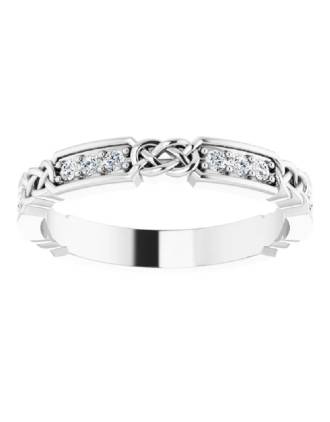
Stainless steel and tungsten Celtic bands run $39.99 to $259.99. Sterling silver knotwork bands start at $99.99. Diamond-set knot rings begin at $269.99. Two-tone silver and 10K gold designs run about $1,499.99, solid 10K and 14K gold roughly $1,499.99 to $3,899.99, and platinum designs from $3,499.99.
Can a Celtic knot ring be used as an engagement ring?
Yes. Many couples choose a Celtic knot design for the engagement ring and add a matching knotwork band at the wedding, and some wear one knot ring for both. If you will wear an engagement ring alongside the band, choose a contour band, which is shaped to sit flush against the engagement ring rather than leaving a gap.
Are Celtic knot wedding rings comfortable for everyday wear?
Comfort fit Celtic knot wedding rings are domed on the inner surface, so the band clears the knuckle easily and distributes pressure across the finger rather than gripping at the edges. Oxidized and embossed knotwork is cut into or raised from the band surface and lies flush enough that it does not catch on clothing.
How do I find my ring size for a Celtic knot wedding band?
Use our printable ring sizer, or measure a ring that already fits that finger and check it against our ring size conversion chart. Wide bands fit more tightly than narrow ones, so for a band 6mm or wider consider ordering a half size up. Fingers also run slightly larger late in the day and in warm weather.
Browse the full Celtic wedding rings collection, or narrow by design with our trinity knot wedding rings, Claddagh wedding rings and Celtic bridal sets. By metal, see silver Celtic wedding rings, 14K gold Celtic wedding rings and platinum wedding rings. Shopping as a couple? See men's Celtic wedding rings and women's Celtic wedding rings. Not getting married? Our Celtic knot rings collection covers everyday and fashion knotwork rings.